


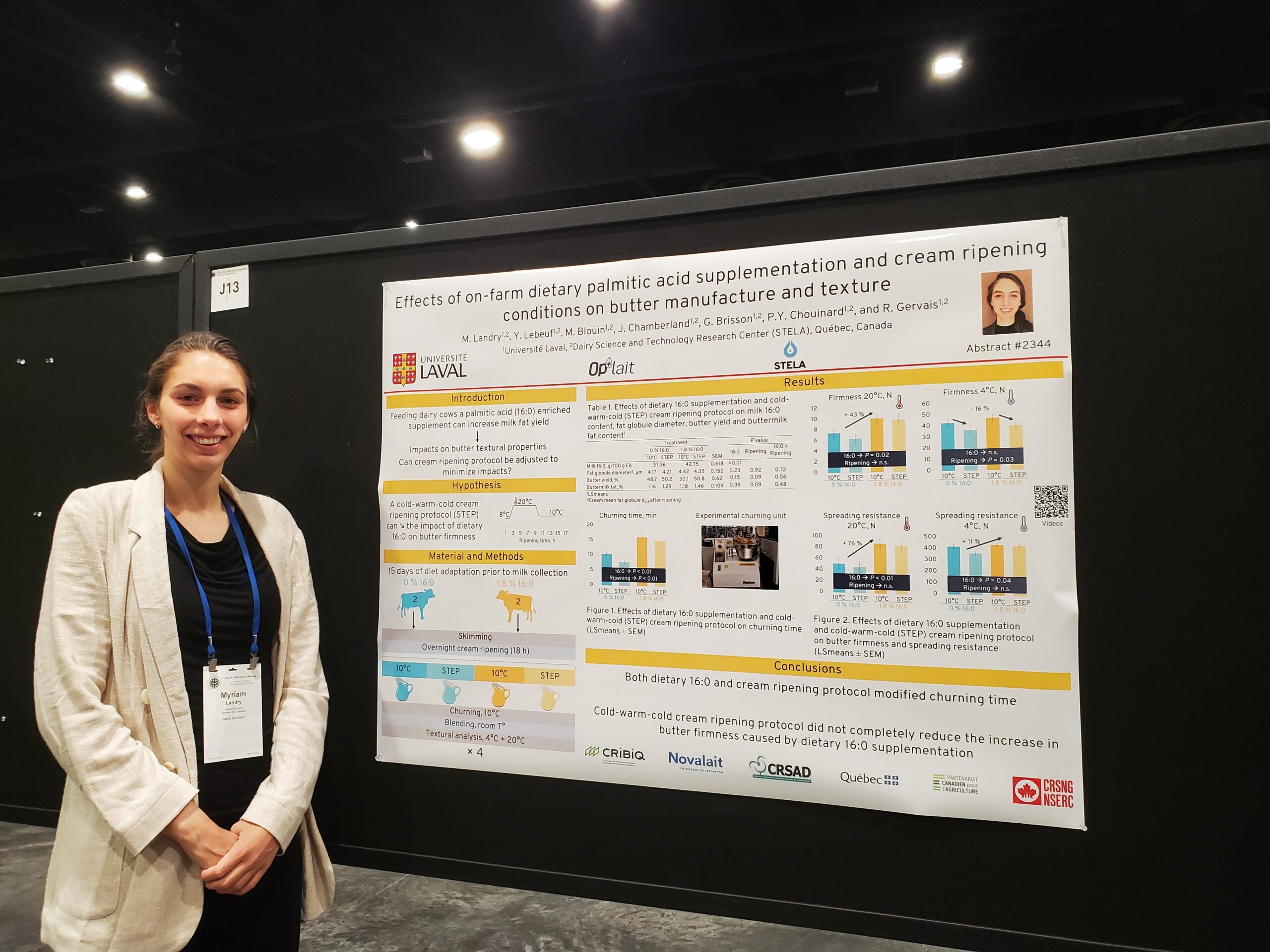
What if dairy cow nutrition and milking practices could influence not only milk composition, but also butter texture? This question guided the work of Myriam Landry, a recent Ph.D. graduate in Animal Science from Université Laval. Through a multidisciplinary approach, she explored how farming practices shape milk and dairy products derived from it.
By Mélanie Lagacé, Communications Consultant and Content Creator Specializing in Agriculture and Agri-Food
Yet Myriam Landry did not grow up on a farm, nor did she dream of becoming a researcher. Her interest in science and agriculture emerged gradually through a series of experiences.
After completing her college studies in science, she traveled to China to work with horses, an environment that had played an important role in her life since childhood. Looking back, certain clues seem to have foreshadowed what was to come. Her mother is a nutritionist, and her father owns a maple syrup operation. Food, animals, and agriculture were always part of her daily life. Upon returning home, Myriam chose to study agronomy at Université Laval to bridge biology and practical applications.
“For me, agronomy represented a form of applied biology,” she summarizes.
During her undergraduate studies, a symposium presentation by Rachel Gervais, Professor of Animal Nutrition in the Department of Animal Science at Université Laval, sparked her interest in dairy production and led her to pursue a master’s degree under her supervision. Her motivation stemmed in part from the remarkable ability of ruminants to transform resources of limited value to humans into nutritious food.
“There is something extraordinary about an animal being able to convert plants we cannot digest into a food as nutritious as milk,” she explains.
A Transformative Experience in France
At the beginning of her master’s program, Myriam hesitated about pursuing a Ph.D. She decided to take advantage of a research internship in France to test her interest. Working with a new team on a different type of study, a meta-analysis, she discovered the same enjoyment in exploring and understanding complex questions.
“I wanted to know whether it was truly research that I enjoyed, or mainly the people I was working with. In France, I realized I had the same enthusiasm despite being in a completely new environment.”
She continued her academic journey and moved directly from her master’s program into doctoral studies, once again under Rachel Gervais’s supervision. On July 13, 2026, she successfully defended her thesis.
From Farm Practices to Finished Products: Research Focusing on What Happens at the Farm
Myriam’s project focuses on everything that happens between the farm and the processing plant: how do farming practices affect milk composition and the quality of dairy products such as butter and cheese?
In particular, she studied lipid supplements, fat sources incorporated into dairy cow diets to meet their energy requirements. While their effects on milk production were already well documented, their influence on milk processing remained less understood.
“We wanted to understand how dairy cow nutrition and certain milking practices affect not only the milk that is produced, but also the quality of butter and cheese,” summarizes Myriam.
The originality of the project lies in its integrated approach, bringing together expertise from several areas within Université Laval’s Faculty of Agricultural and Food Sciences: animal nutrition, butter and cheese processing, and data analysis.
The experiments were conducted at the Deschambault Animal Science Research Centre. Different diets were fed to the cows, and the milk was then processed at Université Laval’s pilot laboratory under conditions designed to simulate industrial production.
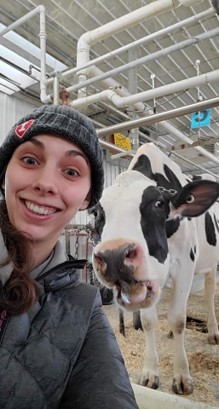
“We operated like a dairy plant, but on a smaller scale,” says Myriam.
In the laboratory, the main processing steps were replicated: pasteurization, skimming, and standardization. Milk composition was standardized for cheese production, while cream fat content was standardized for butter making. The team then produced both butter and cheese. This approach made it possible to reveal how decisions made on the farm can influence the characteristics of finished dairy products.
Distinct Effects from Different Feeding Strategies
The research team compared four fat sources: soybean oil, palm oil calcium salts, tallow, and super stearin, which is rich in saturated fatty acids.
The results showed that not all supplements have the same effects. Soybean oil increased milk production but reduced fat and protein percentages, while also producing softer butter. In contrast, super stearin increased butter firmness when measured at 20°C. These differences are linked in part to the properties of fatty acids: saturated fatty acids melt at higher temperatures than unsaturated fatty acids, which alters product texture.
The team also observed effects on churning time and certain fat degradation phenomena. The impact on cheese was less pronounced, likely due to milk standardization, although fatty acid profiles may influence the ripening process.
Answers That Lead to New Questions
One finding particularly caught Myriam’s attention: the possibility that added dietary fats may also influence milk proteins. Diets containing palm oil calcium salts or soybean oil resulted in lower levels of true protein. With calcium salts, the team also observed a reduction in caseins, proteins that are essential to cheese structure.
“When studying fat supplements, researchers typically focus on their effects on milk fat. We also wanted to understand how they might alter milk proteins.”
This finding, which remains relatively little documented, opens new avenues for understanding interactions between fats and proteins.
Using Data to Better Inform Future Decisions
This knowledge could help producers and processors adjust their practices according to the characteristics they want in their dairy products.
Applying these findings on a large scale remains challenging because realities vary from one processing facility to another. In some small cheese plants, milk comes from a single farm or only a few farms, making the effects of feeding strategies more noticeable. By contrast, some large plants process up to one million litres of milk per day collected from many farms, resulting in milk pooling that may dilute the influence of practices from any one farm. Nevertheless, Myriam sees potential in the rapid assessment of milk composition at processing facilities through infrared analysis, a technology already used for milk and cheese. Research could therefore contribute to improving existing tools to better evaluate the effects of feeding practices.
The approach developed through this project could also serve as a foundation for evaluating new feeding strategies more comprehensively, particularly those aimed at reducing methane emissions while also considering their effects on milk and dairy products.
Using Comedy to Communicate Science
For Myriam, making science accessible also involves science communication. She has shared her findings with various audiences and published articles such as Cows Don’t Eat Big Macs. She even created a scientific comedy act that she performed five times, notably as part of the HIHI Monday event at the Acfas conference. She also won the Audience Choice Award at the 2025 Novalait Techno Forum. Behind this initiative was a serious goal: improving her communication skills.
“I wanted to become someone who is engaging and easy to follow when speaking in public. I figured that if I could perform stand-up comedy, there probably wouldn’t be a more intimidating speaking challenge after that!”
Today, Myriam says she has retired from stand-up comedy, but creativity remains at the heart of her work.
“When a new idea comes to mind, that’s when I remember why I chose to become a researcher.”

Milk Still Has More Secrets to Reveal
Myriam hopes to pursue a postdoctoral fellowship to continue her training and develop her own research projects. She wants to keep exploring what determines milk quality and composition, as well as the many ways milk can be used. From dairy cow nutrition to butter production, she has learned to study a raw material in all its complexity. She now hopes to build connections between disciplines, production stages, and the people who investigate them.
For Myriam Landry, research is not only about finding answers. It is about generating new questions and sharing discoveries clearly enough to inspire others to take an interest.
Learn More About the Project:
- View the Novalait project profile
- Read the article Cows Don’t Eat Big Macs (French only)
- Watch Myriam’s scientific comedy performance (French only)
- View Myriam’s professional profile
- Explore Novalait publications on the topic (French only)
- Read scientific papers published by Myriam and her collaborators

