


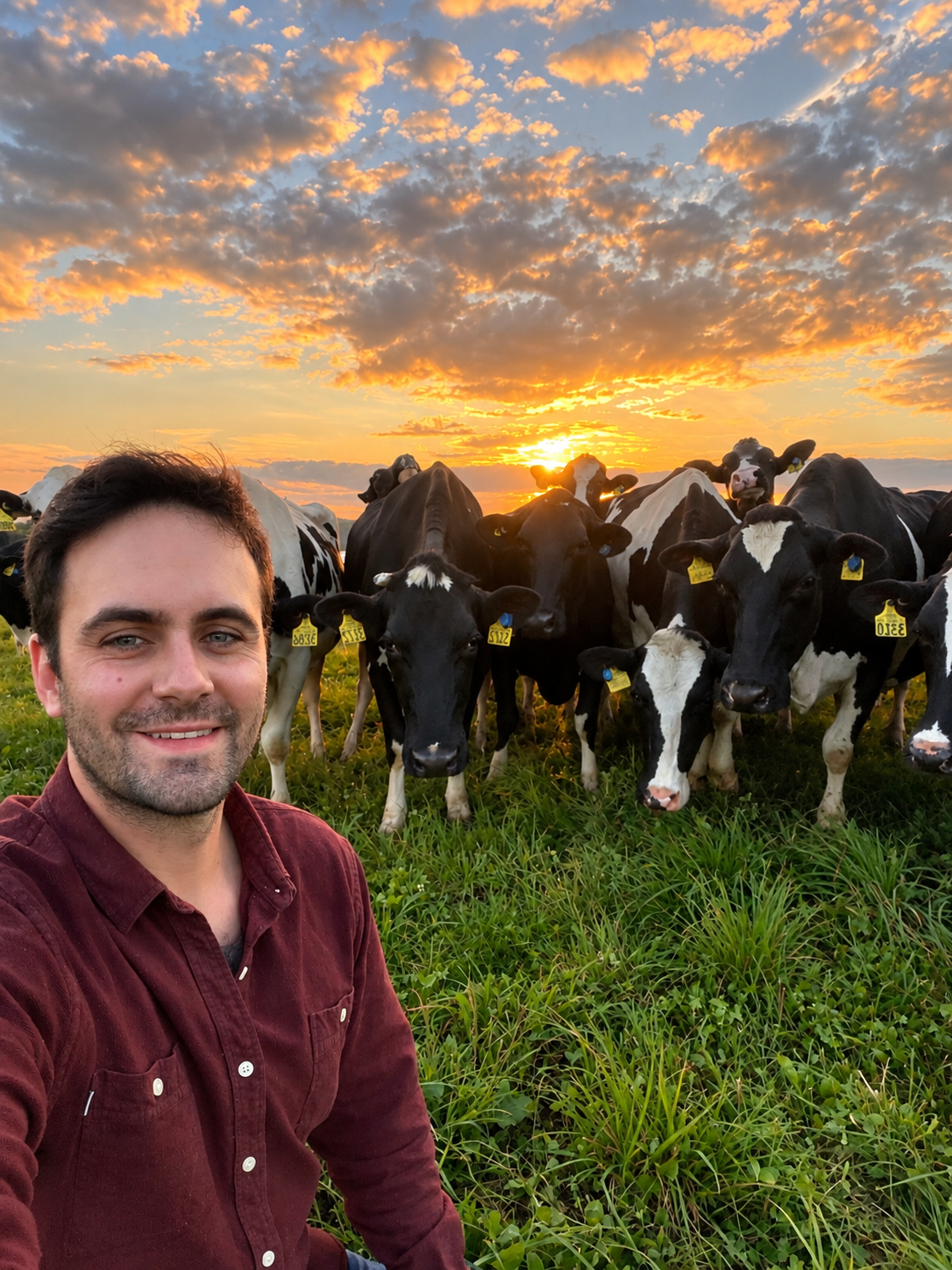
Initially drawn to communications, Félix Huot never imagined that his path would lead him to study what milk can reveal about the health of dairy cows. Today, as a postdoctoral researcher at Cornell University in Ithaca, he investigates how milk analysis can provide insights into an animal’s energy balance and metabolic status. After completing a Ph.D. in Animal Science at Université Laval, he is working to combine cow biology with artificial intelligence (AI) to help develop tools that could support dairy producers in making better-informed decisions.
By Mélanie Lagacé, communications, writing, and content editing professional specializing in agriculture and the agri-food sector
From Communications to Dairy Cows
Originally from Lévis and raised outside the agricultural world, Félix first envisioned a career in journalism. Two stints with Salut Bonjour allowed him to discover the behind-the-scenes reality of television and even present a live news segment. In college, he chose social sciences to pursue studies in communications. Yet his interests gradually shifted toward food origins, self-sufficiency, and vegetable production.
On a family plot of land, he tried growing vegetables for about ten customers. The operation was modest, but the lessons were plentiful. “I was trying to do just about everything, and I was succeeding at almost nothing,” he recalls. One thing became clear: if he wanted to work in agriculture, he needed to learn the trade.
A visit to Université Laval’s Agriculture, Food, and Consumer Week proved to be a turning point. Inspired by the enthusiasm and commitment of the students organizing the event, Félix completed the required science prerequisites and enrolled in the Bachelor of Agronomy program. During his first year, he discovered dairy production at Ferme Phylum. It was love at first sight, both for the cows and for the industry. He offered his services to the farm, but no positions were available. He then approached Ferme Sylva, openly admitting to the producer that he knew nothing about livestock but was hardworking and eager to learn. “Perfect. We start at 4:30 tomorrow morning,” came the reply.
There, Félix gained valuable hands-on experience. When the farm sold its herd, he returned to Ferme Phylum, where a position had just opened. He remained there until 2023 and took on a wide range of responsibilities: milking, artificial insemination, management decisions, supervising interns, launching the farm’s cheese plant, and delivering cheese during the pandemic. He also enjoyed welcoming visitors and explaining farm operations. Perhaps, in a way, it was a return to his early interest in communications.
The Confidence That Changed Everything
During an internship in dairy production consulting with Cargill, Félix enjoyed working with producers but felt the need to deepen his knowledge to better understand their challenges and answer their questions. He turned to Rachel Gervais, a full professor in the Department of Animal Science at Université Laval, whose rigor and passion for dairy cow nutrition he greatly admired.
“On paper, I may not have been the ideal candidate for graduate studies. But Rachel chose to believe in me, and that changed the entire course of my career.”
She offered him an applied research project in collaboration with Éric Paquet, an associate professor in the same department and a specialist in AI and bioinformatics. Félix received a scholarship from the Canadian Dairy Commission, administered in Quebec by Novalait, began a master’s degree, and quickly transitioned into a Ph.D. Along the way, he discovered data science and its potential to improve our understanding of dairy production.
Making Milk Talk
The three parts of his doctoral research all began with the same starting point: a milk sample collected during routine milk recording and analyzed by Lactanet using infrared spectroscopy. Milk absorbs certain wavelengths depending on the molecules it contains. The resulting output, consisting of more than a thousand values, forms what Félix describes as the milk’s “digital fingerprint.”
This method is already used to determine fat, protein, and lactose content. However, the spectrum contains other signals as well. Since nutrition, metabolism, and health can alter milk composition, AI could identify indicators of what is happening inside the animal.
The first part focused on subclinical ruminal acidosis, a disorder associated with excessively acidic rumen conditions. Difficult and costly to measure, this condition can negatively affect digestion, production, and overall health. Using pH data collected from sensors, the research team developed a model capable of detecting a signal in milk. Although the tool cannot yet provide individual diagnoses, it may help monitor herds and identify situations of concern.
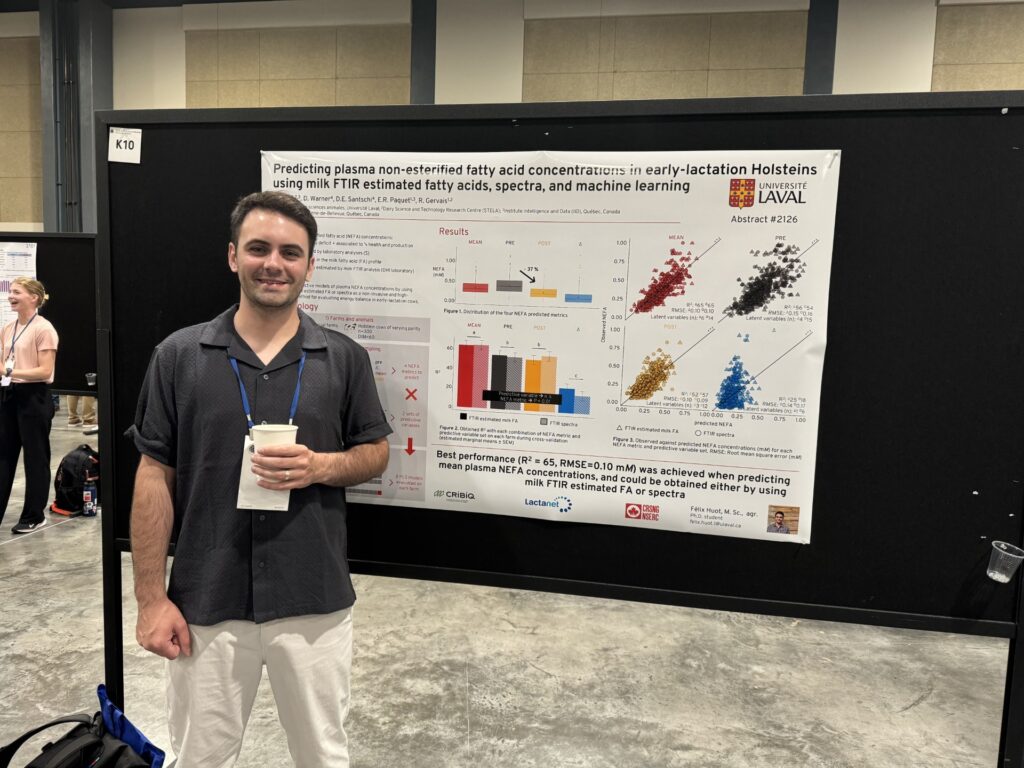
The second part examined energy deficits in early lactation. Nutritional requirements increase more rapidly than a cow’s ability to consume feed. As a result, cows draw on their body reserves, and excessive mobilization raises the risk of metabolic disorders. Some of the fatty acids released during this process end up in the milk, providing clues about the animal’s energy status.
Finally, the third part aimed to predict milk coagulation properties and cheese-making potential. Using a microplate method that requires very small sample volumes, researchers compared milk from numerous cows and evaluated coagulation and curd-firming rates.
From the Laboratory to the Farm
Lactanet is a partner in all three research parts and could ultimately make use of the findings. However, Félix emphasizes that before any tool can be offered to producers or their advisors, it must be validated across multiple conditions and farms.
His work has also led to a partnership with Belgium’s Walloon Agricultural Research Centre. An international consortium is pooling data from several countries to determine whether a shared model can be more robust than regional approaches while still being adapted to Quebec conditions.
“Ultimately, producers are the ones generating these data. The best way to return value on their investment is to turn those data into tools that help them make better management decisions.”
Expanding the Playing Field at Cornell
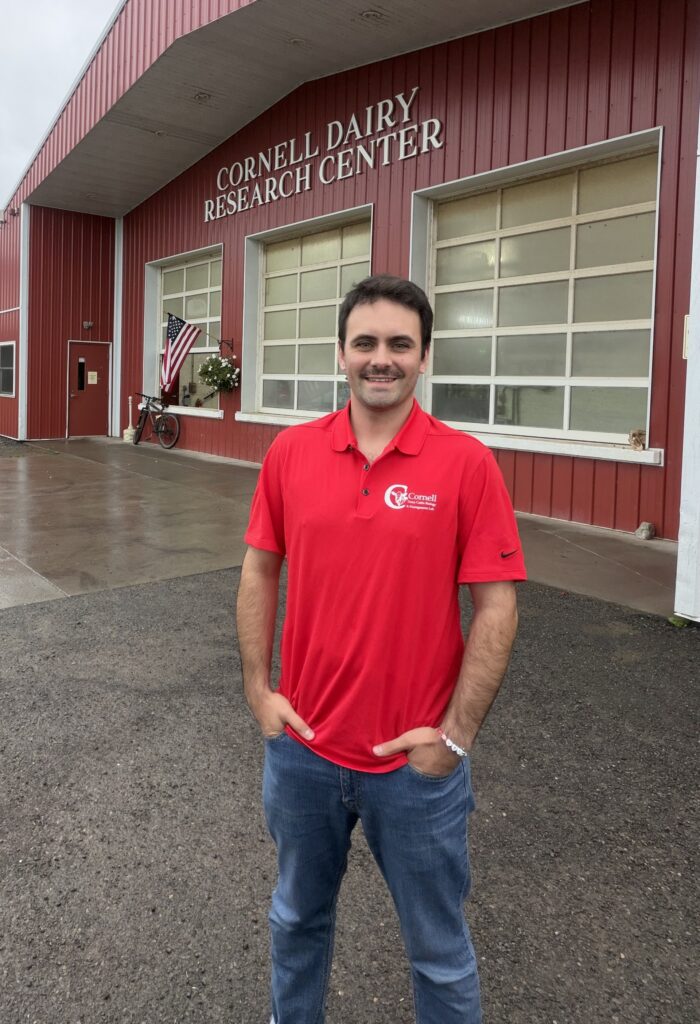
Félix is pursuing this ambition through a postdoctoral fellowship at Cornell University, supported by a scholarship from the Natural Sciences and Engineering Research Council of Canada (NSERC). Within the research team led by Professor Julio Giordano, he works with the Farm of the Future, a university farm where emerging technologies are tested and developed. There, he is deepening his expertise in the use of milking robots, smart collars, sensors, and cameras
One question guides the team’s work: What decision are we trying to make based on the data and the technology? “An approach may be impressive, but it has to provide value on the farm,” he explains.bHe is currently involved in developing a low-cost virtual fencing system that could simplify the management of grazing cows and become accessible to smaller farms, including those in emerging economies.
His objective is clear: to return to Quebec, continue his career as a dairy production researcher, and put his expertise at the service of local producers.
Pursuing Research Without Putting Life on Hold
As the father of two young daughters, Clémence and Violette, Félix is committed to challenging the notion that graduate studies require putting one’s personal life on hold. His daughters remind him of what matters most and give additional meaning to his work. He would never want them to think they held him back from pursuing his dreams. Instead, he hopes to pass on his curiosity and his determination to follow through on what truly inspires them.
Félix has never stopped wanting to understand and then share what he learns. Today, he is making milk and data speak, using technology to serve a very practical purpose: helping dairy producers make more informed decisions.
Learn More About the Project:
- Watch Félix’s presentation on his project on ruminal acidosis (French only)
- Watch Félix’s presentation on his project examining milk plasma fatty acid concentrations (French only)
- Listen to the podcast featuring Éric Paquet and Félix Huot discussing the prevalence of subacute ruminal acidosis (SARA) in Quebec dairy herds

