


Abderrazek Temimi did not have a clear-cut plan for his professional career. He had areas of interest, but nothing specific he wanted to accomplish. However, his passion for science and technology, combined with his drive and determination, allowed him to forge a path of his own. Today, a master’s research project on cheese analysis, combining science and technology, stands as the culmination of that journey.
By Sandrine Demers, Communications Strategist, Tricot Communication
Born in Tunisia, in the northern suburbs of Tunis, Abderrazek recalls being interested in science from a very young age. As far back as he can remember, he watched C’est pas sorcier, a science television program broadcast on TV5 that showcased scientific experiments. This interest was reinforced in high school, particularly thanks to a science teacher who regularly conducted experiments and introduced Abderrazek to laboratory work.
It was therefore only natural that he began his university studies at the Institute of Applied Biotechnology Sciences in Tunis, specializing in food control and safety. One of his first internships involved analyzing a newly identified invasive crab species. Since very little was known about it, Abderrazek’s role was to characterize the species through various analyses. It was a comprehensive process of observation and data collection, an experience that was as memorable as it was positive for the student.
After completing his bachelor’s degree, Abderrazek did not have a specific plan. He was torn between entering the workforce or continuing his studies to broaden his career prospects. The opportunity to pursue a master’s degree in Italy therefore came at the perfect time. More specifically, it was thanks to a scholarship from the Italian Ministry of Foreign Affairs that the student’s international academic journey began.
Abderrazek also admits that he has always had a strong interest in computer science. He wanted to develop his skills in that area. However, it can be more difficult to gain admission to a European university when changing fields of study rather than continuing in the same discipline. This is why he chose to pursue a research-based master’s degree in food control and safety in Italy, while still nurturing his interest in computer science. His experience in Italy was not always easy. Even though he had previously learned Italian, Abderrazek struggled during his first year of graduate studies. Learning a language and using it occasionally in recreational settings is one thing, but mastering it within a university environment is another challenge entirely!
At the end of his master’s degree, Abderrazek took some time to travel through France, Italy, and even Tunisia. Upon returning home, he decided to test the job market and worked in an ice cream manufacturing plant as a laboratory quality technician. Among other responsibilities, he monitored the cold chain to ensure there were no disruptions.
Through this job, Abderrazek realized he was not fully fulfilled, both in terms of salary and the level of stimulation provided by his work. That is why he turned toward computer science by taking a course in data analysis, also known as Data Science. He had already been introduced to the field during his master’s studies in Italy, and it had sparked his curiosity.
“I tried to be as independent as possible and avoid making the same mistakes, but sometimes, if opportunities do not exist, you have to create them.”
In the meantime, love entered his life. The student met his partner, who also worked in academia, more specifically in biological engineering. She decided to pursue a master’s degree in Canada. Her move prompted Abderrazek to explore opportunities in the country that would allow him to balance both his professional and personal life. He came across the profile of Julien Chamberland, Assistant Professor in the Faculty of Agricultural and Food Sciences at Université Laval, whose research focuses on technological tools for cheese analysis. The project combined computer science and science, the best of both worlds for Abderrazek.
Building a Cheese Classification Model
Cheese classification is a demanding task performed by certified cheese graders. It serves two purposes: determining whether a batch meets quality standards and assessing whether its characteristics make it suitable for block, sliced, or shredded formats. However, there is a shortage of new professionals entering the cheese grading profession. In addition to lengthy and expensive training, a career in this field requires a strict lifestyle, including avoiding tobacco, alcohol, and other habits, not only to preserve taste sensitivity but also to protect worker health and safety. Tasting large quantities of cheese requires particular dietary habits and an active lifestyle. Furthermore, this type of analysis remains highly subjective, as results can vary from one grader to another.
With regard to the sensory evaluation of cheese, among other aspects, Abderrazek explains that cheese graders use an established vocabulary, but each company has developed its own terminology. Moreover, each grader within a company may have a different approach. As a result, it is difficult to standardize a single vocabulary.
Abderrazek’s research project therefore aims to address this challenge by building a model designed to facilitate cheese classification. The student explains that the primary goal of his research is to develop a proof of concept demonstrating to industry stakeholders that a cheese classification model is feasible.
In practical terms, the study focused on block cheddar cheeses from two Canadian companies. Initially, the project planned for Abderrazek to manufacture the cheeses himself, but the approach was later modified. Instead, a partnership was established with processing companies that classified the cheeses and then sent samples to the research team for analysis at Université Laval’s food physicochemistry laboratory. Abderrazek collected the resulting data to build and test several predictive models using different combinations of variables and criteria. Ultimately, the research team selected the highest-performing models to interpret laboratory analysis results and support decision-making in processing plants. This work falls within what is commonly known as Data Science. It combines mathematics, statistics, and computer science. One could say that Abderrazek was truly in his element!
The results were positive. Abderrazek successfully developed a predictive model capable of classifying mild, medium, and old cheddar with nearly 90% accuracy. However, this is information that master cheesemakers already know from the beginning of the production process. Nonetheless, the findings demonstrate that the analysis is based on clear physico-chemical parameters, making this type of prediction possible.
Another aspect Abderrazek sought to predict was whether cheese would ultimately be suitable for block or sliced formats. Sliced cheese requires different properties; for example, it must not leave residue or stick to the cutting blade. Defective cheese can slow down processing lines and generate additional costs. The student also obtained promising results in predicting slicing suitability, although additional work remains to be done through more targeted analyses (e.g., colloidal calcium vs. total calcium).
Overall, Abderrazek believes that his research project fulfilled its objective, namely demonstrating the potential of artificial intelligence in the cheese processing sector.
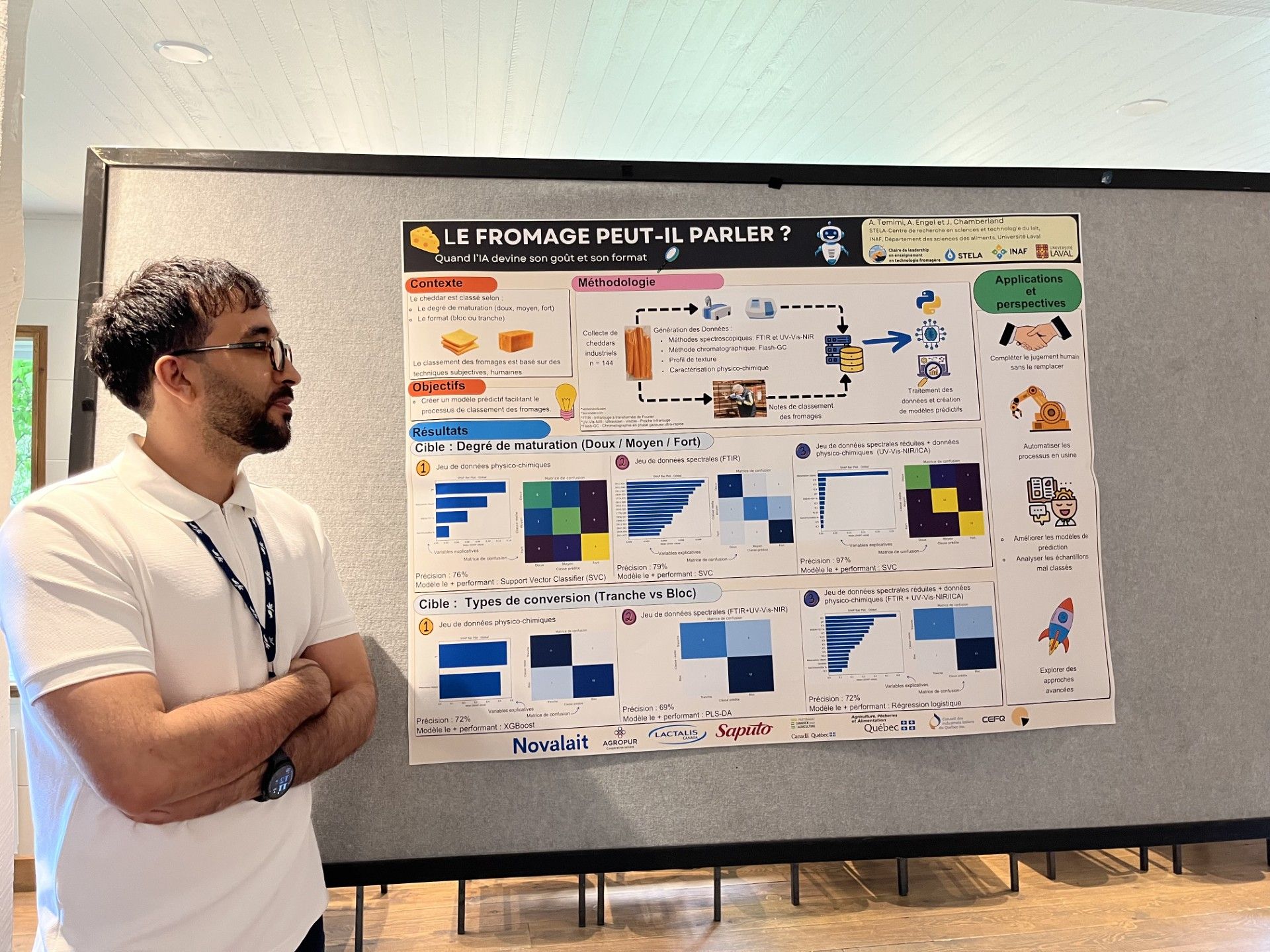
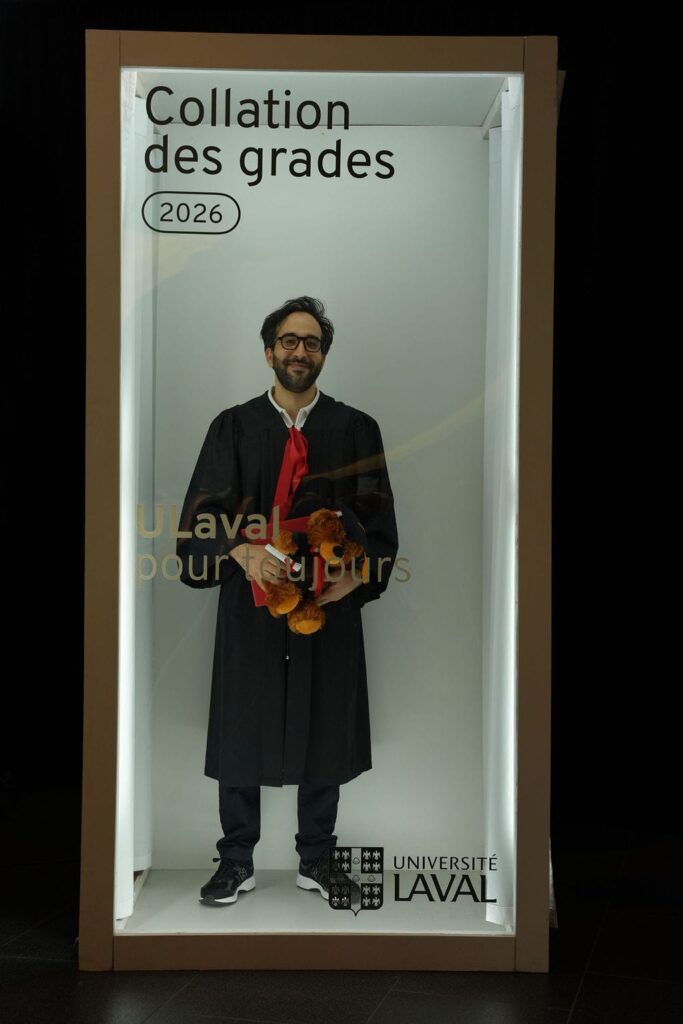
In 2025, Abderrazek presented part of his research findings and even received an award. The research concluded in March 2026, at the same time as the completion of his master’s degree. His thesis is also available in Université Laval’s institutional repository (CorpusUL).
His Superpower: Perseverance
Abderrazek hopes that his research will mark the beginning of something transformative for the cheese industry. The student even developed a small application to share with participating companies to demonstrate the potential of the models he created. It remains to be seen whether this work will lead to future opportunities.
Going forward, Abderrazek continues to work for Agropur as a plant technician in Quebec City, a position he began during his master’s studies. However, this is far from the end of his academic journey. He hopes to further expand his expertise in artificial intelligence, perhaps through a certificate program. For now, he is in the process of having his international credentials assessed and recognized in Canada.
In light of everything he has accomplished, Abderrazek is filled with pride.
“It was not easy working in fields such as computer science and predictive tools, but sometimes stepping outside your comfort zone pushes you to do truly remarkable things.”
He credits his perseverance, which he considers the key to his success. The student emphasizes that his knowledge is not innate. Rather, it is his curiosity and eagerness to learn that have led him toward success. It shows that simply wanting something and genuinely enjoying it can drive professional achievement, and Abderrazek’s journey is a perfect example of that.
To learn more about the project:
- View the research project web page
- Read Abderrazek’s master’s thesis (French only)
- View the poster presented at the 2025 Techno Forum (French only)

